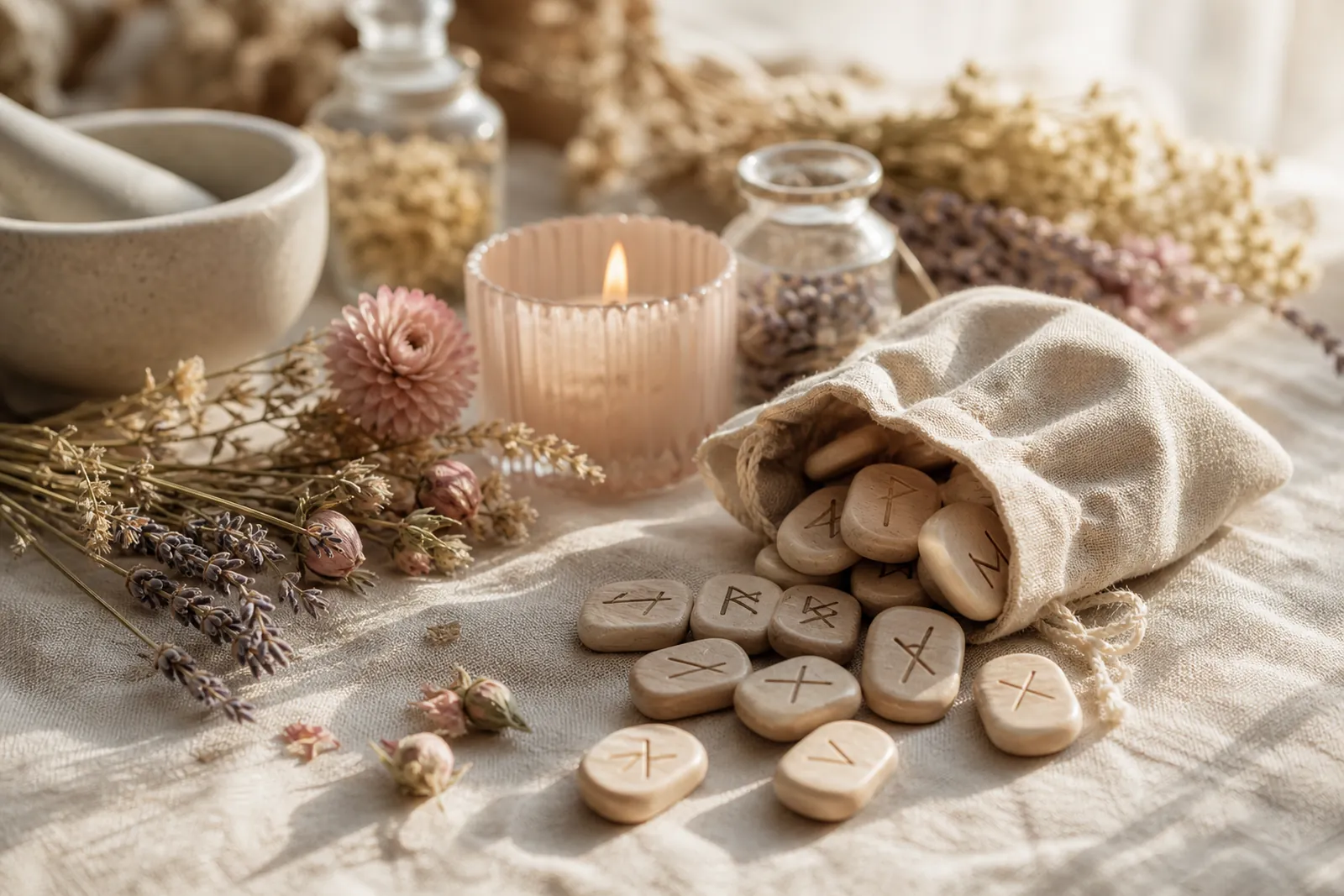
To read runes, hold your question in mind, draw or cast a small number of rune stones, and consider each symbol's traditional meaning alongside what feels true to you. A single rune pulled from a bag is the best place to begin, and you can build up to three runes once the symbols feel familiar.
What are runes?
Runes are the letters of early Germanic alphabets, used across Northern Europe and Scandinavia and later across Britain by Anglo-Saxon and Norse peoples. The oldest set is called the Elder Futhark, named for its first six letters, and it has 24 symbols. They were carved into stone, bone and wood, and the word rune is often linked to an old word meaning secret or whisper.
Modern rune casting draws on this inheritance, though much of how we use runes for divination today is a relatively recent practice. It is best approached as a reflective ritual, with respect for the history behind the symbols.
Choosing a rune set
Rune sets usually come as 24 stones, tiles or wooden pieces, often with a pouch to hold them. Some include a blank rune, which is a modern addition rather than part of the old alphabet. Smooth stones feel good in the hand, and wood has a warm, old-world look. Browse our runes to compare materials, and look for crisp, readable symbols and a guide card or booklet to get you started.
A bag is useful for drawing, and a plain cloth works well as a casting surface. If you would like to create a little reading space, our altar and witchcraft tools include cloths, dishes and other accessories.
Some common rune meanings
Here are a few runes beginners often meet first, with their traditional associations:
- Fehu: cattle and wealth; abundance, resources and what you hold dear.
- Uruz: the wild ox; strength and raw vitality.
- Ansuz: a mouth or god; communication, messages and wisdom.
- Raido: a journey; travel, movement and the road ahead.
- Gebo: a gift; exchange, generosity and partnership.
- Wunjo: joy; harmony and contentment.
- Isa: ice; a pause, stillness or a period of waiting.
- Othala: inheritance; home, family and roots.
Meanings differ between books, so use a guide as a starting point and make notes on what each rune seems to say to you.
How to read runes step by step
- Prepare your space. Clear a small surface, light a candle or some incense and settle your thoughts. A stick from our incense sticks makes a pleasant marker for the start of a reading.
- Ask a question. Keep it open, such as: what should I focus on this week?
- Draw the runes. Stir the stones in the bag, then pull them out one at a time without looking.
- Read the symbol. Look at the shape and think about the meaning in your guide.
- Reflect and record. Write down what you drew and how it applied to your question.
Simple rune casts to try
- One rune: a daily draw, giving a theme to carry through the day.
- Three runes: read left to right as past, present and future, or as situation, challenge and outcome. The three-rune draw is a classic.
- A scattered cast: tip all the runes gently on to a cloth and read only those that land face up, with the nearest to you speaking most directly to your question.
Runes that fall face down are usually set aside. Reading them together as a short sentence, like a line of old poetry, often brings the best results.
Runes sit comfortably with other forms of divination. You might enjoy tarot decks and accessories for more detail, or a pendulum for quick answers. Many people also mark the turning seasons with the Wheel of the Year and draw a rune at each festival as a seasonal check-in.
As with all divination, runes are a way of reflecting on your own situation and are not a replacement for professional advice on medical, legal or financial matters.
It helps to keep a small notebook of your draws. After a month or two you will begin to see patterns, such as a rune that keeps returning, and those patterns are often more revealing than any single reading. Learn two or three runes at a time and revisit them often rather than trying to memorise all twenty-four at once.
Bring it home
A set of runes is a small, portable companion that is simple to learn a little at a time. When you are ready to begin, take a look through our tarot, runes and divination and choose the set that feels right in your hand.
Questions and answers
What are the Elder Futhark runes?
The Elder Futhark is the oldest known runic alphabet, used in Northern Europe from about the second century. It has 24 symbols, and most modern rune sets are based on it. The name comes from the sounds of its first six letters.
How many runes should I draw for a reading?
Beginners usually start with one rune for a daily theme, then move on to three for a past, present and future reading. Drawing fewer runes makes it easier to learn each symbol and note down your own impressions.
Do I need to make my own runes?
Not at all. Many people enjoy making their own, but a ready-made set is perfectly good for readings. What matters is that you like handling the stones and that the symbols are clear enough for you to read comfortably.


