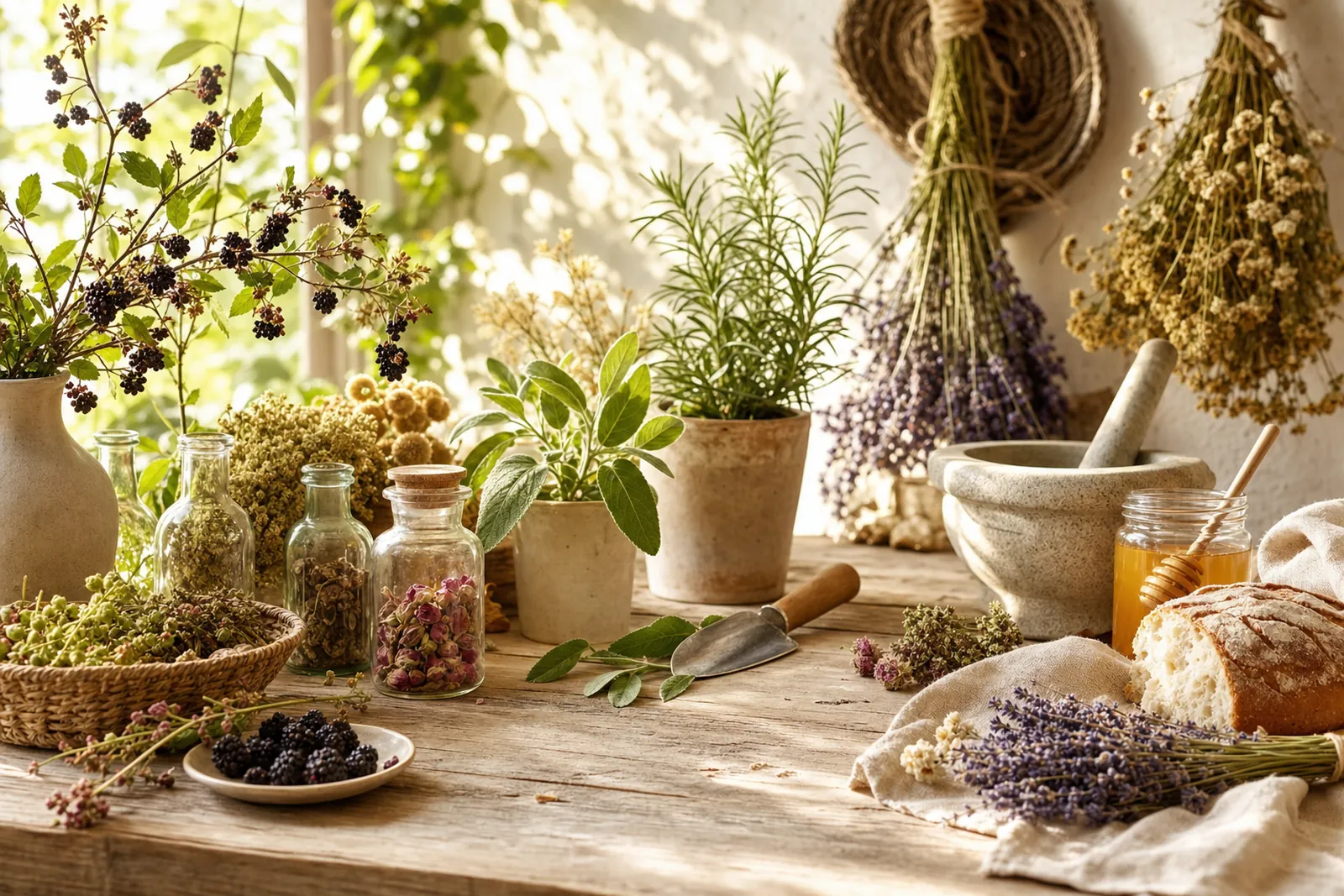

Hedge magic is a quiet, nature-based way of practising folk magic, rooted in the seasons, the plants of the hedgerow and the small rituals of home. A hedge witch usually works alone, paying attention to the land, the moon and the turning year, and sees the hedge as a symbol of the boundary between the everyday world and the wild.
It asks for very little: a walk you take often, a notebook, a candle, and the patience to notice what changes from week to week. This guide explains where the idea comes from, what a hedge witch actually does today, the tools many people like to keep close, and how to begin in a way that feels calm and entirely your own.
What does the "hedge" in hedge magic mean?
Start with the real thing. Hedgerows have shaped the British countryside for centuries, and some are very old indeed. For much of history the hedge marked the edge of the village: on one side lay the cottages, gardens and tilled fields, and on the other the woods, heaths and wild places. The hedge was a living boundary, full of blossom, berries, birds and thorns, and people relied on it for firewood, shelter and fruit.
In folklore, edges like this are rarely ordinary. Thresholds, crossroads, shorelines and hedges are the places where one thing becomes another, and many old stories place magic there. Modern practitioners take the hedge as a metaphor too: the boundary between this world and the otherworld, between waking and dreaming, between what we know and what we sense. "Crossing the hedge" is a phrase some hedge witches use for meditation, dreamwork, divination and quiet, inward reflection.
There is also an old word puzzle behind the name. Some writers connect the English word "hag" and the German "Hexe" with an Old High German word, hagazussa, sometimes interpreted as "one who sits on the hedge". Scholars do not agree on its meaning, so it is best enjoyed as a lovely possibility rather than a settled fact.
Where hedge magic comes from
Folk practice and the cunning folk
For centuries, ordinary people in Britain and across Europe kept a wealth of small, practical customs: a sprig of rowan over the door, a horseshoe on the stable, a charm spoken over butter that would not churn, a love divination at Hallowe'en. Much of this was not thought of as witchcraft at all. It was simply how a household looked after itself through the year.
Alongside these everyday customs were the cunning folk, local men and women whom neighbours might visit for help with finding lost property, protecting a home or livestock, or glimpsing what the future might hold. Historians have shown that they were a familiar part of village life in many parts of Britain for a long time. Their methods varied enormously and they rarely wrote anything down, so it is wise to be careful with any claim that today's practices are a direct continuation of theirs.
The modern hedge witch
The term "hedge witch" in its modern sense is fairly recent. It was popularised in the late twentieth century, notably by Rae Beth's 1990 book Hedge Witch, which described a solitary, nature-centred path for people practising on their own rather than in a coven. Since then many authors and practitioners have added their own ideas, and hedge magic now draws on folklore, seasonal celebration, plant lore and personal reflection.
It is most honest to describe hedge magic as a modern practice inspired by older folk ways, rather than an unbroken tradition. That does not make it any less meaningful. Most people find that the old customs give their practice roots, while their own daily attention gives it life.
What does a hedge witch do today?
There is no rulebook, and no two hedge witches practise in quite the same way. Even so, a few threads run through most people's practice.
Follows the seasons
The turning year sits at the heart of hedge magic. Many practitioners mark the eight festivals of the modern Wheel of the Year, from Samhain at the end of October to Lammas at the start of August, while others simply note the first blackthorn blossom, the longest day or the first frost. Our guide to the Wheel of the Year for beginners walks through each festival, and our Wheel of the Year calendar shows what is coming next.
Learns the plants
Getting to know the plants along your own lane or park edge is one of the gentlest parts of the practice. Elder, hawthorn, rowan, hazel and holly all carry centuries of folklore, and learning their stories, their seasons and how to recognise them is a practice in itself. Our guide to hedgerow plants and their folklore is a good place to begin. Many hedgerow plants and berries are toxic and should never be eaten unless identified by an expert, so admire, sketch and photograph rather than pick.
Keeps a magical home
Hedge magic is often described as hearth-centred. The home is where much of the work happens: a candle lit at the kitchen table, a bowl of seasonal finds on the windowsill, the house swept and aired at the start of a new season. Small, repeated acts like these are the backbone of many people's practice, and they fit easily around work and family.
Works with the moon
Many hedge witches keep moon notes, writing a line or two at each new and full moon about what they hope to begin or let go. Our moon calendar shows the phases for the month ahead, and our full moon ritual offers a simple evening practice to try.
Crosses the hedge, quietly
The otherworldly side of hedge magic is usually gentle and reflective: paying attention to dreams, sitting in meditation, or using a divination tool as a prompt for intuition. Tarot, runes and pendulums are all popular, and none of them asks you to believe anything in particular before you begin. If you are curious, our guide on how to read tarot for beginners is written for complete newcomers.
Hedge witch, green witch or kitchen witch?
You may come across several overlapping labels as you read more. Broadly, a green witch focuses on gardens and growing things, a kitchen witch on the hearth, cooking and home, and a hedge witch on the boundaries: the seasons, the wild edges and the space between worlds. Most people borrow from all three. Our gentle comparison of the hedge witch, green witch and kitchen witch explains the differences, and why you do not have to choose just one.
Common hedge magic tools
A hedge witch traditionally used whatever the household already had, and that is still the best approach. You do not need everything here, and nothing needs to be expensive. These are the things many practitioners find themselves reaching for:
- A Book of Shadows or notebook for seasonal notes, plant observations, moon notes and dreams. A deckle-edged Book of Shadows feels special, but any notebook you love will do.
- Candles for marking a moment, a festival or a weekly ritual. Plain dinner candles are perfect, and coloured ritual and spell candles are a pleasure for particular intentions.
- A cauldron, the classic symbol of the hearth, used for burning resin incense or folded paper wishes, or simply for holding a candle. A small cast iron cauldron suits a hearth or windowsill altar.
- Incense or resin to mark the start of a ritual and scent the room. Resins on charcoal have an old-fashioned depth, while sticks and cones are simpler for every day.
- A pestle and mortar for grinding dried culinary herbs, resins and petals for incense blends or seasonal displays.
- A wand, often wooden, used to direct your attention during a ritual. Many people prefer one made from a wood they feel a connection with.
- An offering bowl for seed left out for the birds, a little bread left in thanks, or the seasonal finds from your walks.
Whenever you use candles, charcoal or incense, keep them on a heatproof surface, away from curtains and dried plants, and never leave a flame unattended. A cast iron cauldron gets very hot, so stand it on a tile or trivet. For a fuller look at essentials and nice-to-haves, read hedge magic tools: what you actually need, or browse our full range of altar and ritual tools.
How to begin practising hedge magic
The best beginnings are small. Rather than trying to learn everything at once, choose a few simple habits and let them grow with the seasons. Our step-by-step guide to starting a hedge magic practice at home goes into more detail, but here is the shape of it:
- Choose a path you can walk often. A country lane, a park edge, a canal towpath or the hedge at the end of your road. Walk it once a week and notice what has changed.
- Start a notebook. Write the date, the weather, what is flowering or fruiting and how you feel. Over a year this becomes your own almanac.
- Make a small altar. A windowsill or shelf is enough: a candle, a dish of seasonal finds, perhaps a stone or a picture that means something to you.
- Light a candle once a week. Sit for a few minutes, think about the week ahead and set a simple intention.
- Follow the moon. Note the new and full moon each month and write a line about each.
- Learn one plant a month. Its name, its folklore, its season and how to recognise it safely from a distance.
- Mark the next festival. Whatever is coming up on the Wheel of the Year, do one small thing to honour it.
A few gentle principles
Hedge magic tends to come with a quiet ethic, and these principles are shared by many practitioners:
- Respect the land. Never uproot wild plants, take nothing where a plant is scarce, and ask the landowner before gathering anything on private ground.
- Leave it better. Picking up litter on your walk is a small ritual in itself.
- Stay safe. Folklore is not a guide to eating or using plants. Admire, learn and record, and leave the rest.
- Keep it simple. A hedge witch's tools were always the household's tools. A few things you love are worth more than a cupboard of things you never use.
- Be honest about history. Enjoy the folklore, hold the claims lightly, and let your own experience be enough.
Who is hedge magic for?
Hedge magic suits anyone who feels drawn to the seasons, to old stories and to quiet, private ritual. You do not need to live in the countryside or own a garden. A single tree on your street, a scrap of hedge beside a car park or a window box can teach you the turning of the year just as well as a meadow. It also suits busy lives, because most of its practices take minutes rather than hours, and none of them needs an audience.
Many people come to it after years of loving folklore, walking or gardening without a name for what they were doing. If that sounds familiar, you may already be closer to the hedge than you think.
Bring it home
If you would like a starting point, a notebook, a candle and a single seasonal object on a windowsill are more than enough. When you are ready to add to your altar, our Green Man collection brings a little of the old woodland spirit indoors, with candles, carvings and notebooks that sit happily beside the treasures from your own walks.
Questions and answers
What is the difference between a hedge witch and other witches?
Witchcraft today includes many paths, from coven-based traditions to solitary folk practice. A hedge witch usually practises alone and focuses on the seasons, wild plants, the home and quiet otherworldly work such as dreams and divination, taking the hedge as a symbol of the boundary between worlds. Many people combine hedge magic with other approaches.
Is hedge magic an old tradition?
Hedge magic draws on long-standing British and European folk customs, such as seasonal celebrations, plant lore and household charms. The term hedge witch in its modern sense, though, was popularised in the late twentieth century, notably by Rae Beth's 1990 book Hedge Witch. It is best described as a modern practice inspired by older folk ways.
Do I need to join a coven to practise hedge magic?
No. Hedge magic is usually a solitary practice, which is part of its appeal. You can practise entirely on your own, at your own pace, in your own home and on your own walks. Some hedge witches enjoy meeting others at seasonal gatherings or online, but there is no need for initiation, membership or a teacher to begin.
What do I need to start hedge magic?
Very little. A notebook for seasonal and moon notes, a candle and a path you can walk regularly are enough to begin. Over time many people add a small cauldron, incense, a pestle and mortar or a wand. Choose a few things you love and will genuinely use, rather than buying everything at once.
Can I practise hedge magic if I live in a town?
Yes. Hedge magic is about regular, gentle attention, not acres of countryside. A park edge, a canal towpath, a churchyard or a single tree on your street can be your hedgerow. A windowsill altar, a few pots of herbs and a notebook of seasonal changes will connect you to the turning year wherever you live.