









































Walk into an old British farmhouse, church or barn and you may be standing among protective magic without knowing it. Scratched circles by a fireplace, a horseshoe above a door, a shoe hidden in a wall, a bottle of pins buried under the hearth: for centuries, ordinary people used these to keep their homes, families and animals safe.
This guide looks at the most common protection charms in British folklore, what historians and archaeologists have found, and how hedge witches keep these customs alive today. You can find every hedge magic guide on our Hedge Magic page.
Why protect the threshold?
In folklore, the weak points of a house were its openings: doors, windows and, above all, the chimney. These were the places where the outside world, and anything unwelcome in it, might slip in. So that is exactly where protective charms gathered.
Witch marks
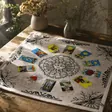
Historians call them apotropaic marks, from a Greek word meaning to turn away evil. They are scratched or burned into wood and stone near doors, windows and fireplaces, mostly from about the 1500s to the 1700s. The most common include:
- Daisy wheels, or hexafoils: a flower-like pattern drawn with a pair of compasses.
- Overlapping Vs, often thought to stand for Virgo Virginum, the Virgin of Virgins, invoking Mary's protection.
- Burn marks: teardrop-shaped scorches made deliberately with candles or tapers.
In 2016, Historic England asked the public to help record witch marks, and thousands have been found, in places from cottages to great houses and caves. Look carefully next time you visit an old church porch or a historic house.
Horseshoes and iron
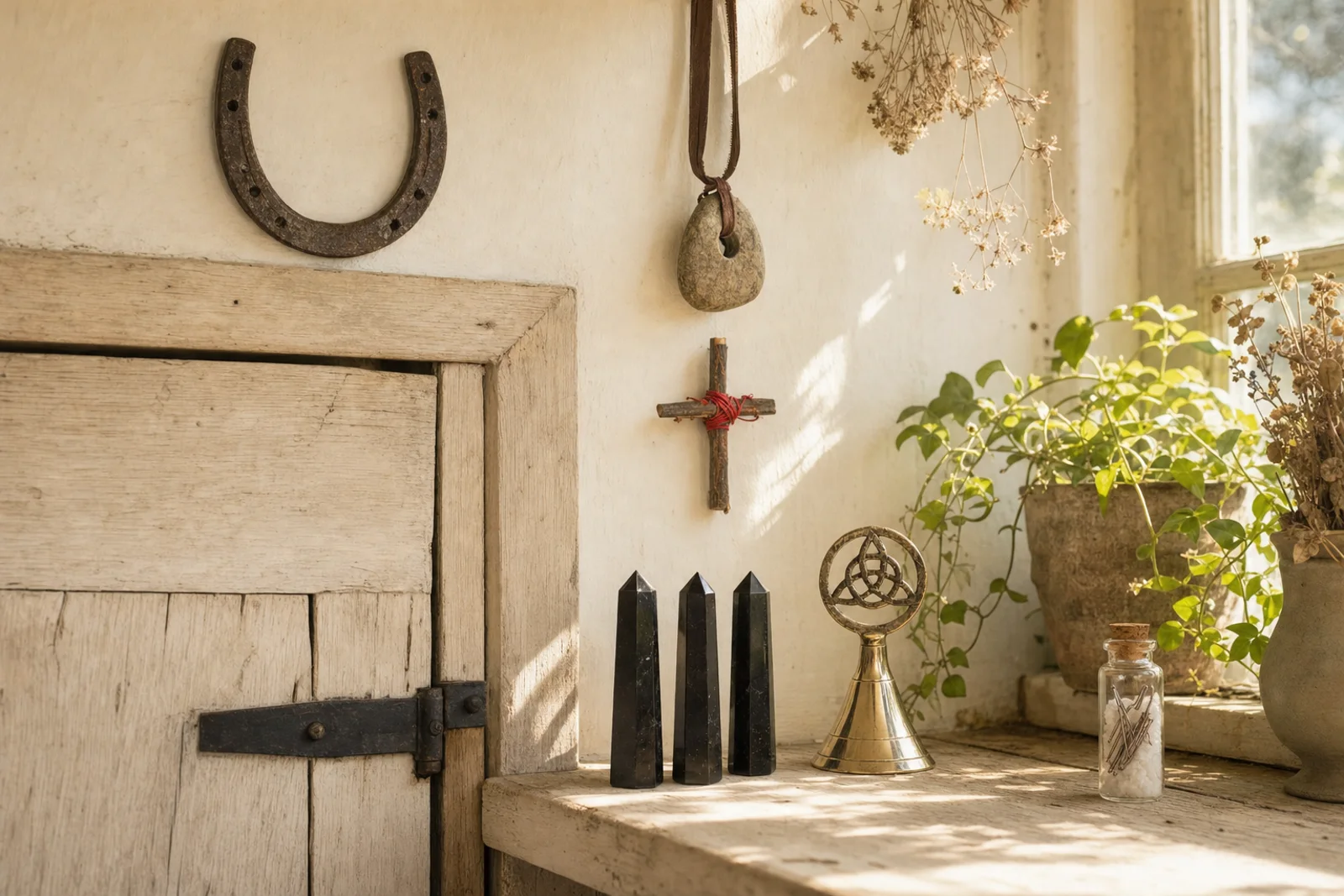
Iron has long been thought to repel ill luck and the fair folk. Horseshoes were nailed over doors, on stables and on ships' masts. A well-known legend says Saint Dunstan, a blacksmith and Archbishop of Canterbury, nailed a horseshoe to the Devil's hoof and only removed it on the promise that he would never enter a house with a horseshoe over the door. In much of Britain, the horseshoe is hung with its open end upwards, to hold the luck in.
Hagstones
A hagstone is a stone with a natural hole worn through it, usually found on beaches and in rivers. In British folklore they were hung on bedposts to prevent nightmares, in stables to stop horses being "hag-ridden" at night, and by doors for luck. Some people say that looking through the hole lets you see the fair folk.
Rowan
Rowan, or mountain ash, was one of the most protective trees in British and especially Scottish folklore. Its berries have a tiny five-pointed star at the base, and red was always considered a protective colour. Small crosses of rowan twigs bound with red thread were hung over doors and in cow byres, and the old rhyme says rowan tree and red thread hold the witches all in dread. Our guide to hedgerow plants and their folklore tells more of the rowan's story.
Witch bottles
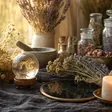
Witch bottles were made in England mainly from the 1600s. Stoneware jars, and later glass bottles, were filled with bent pins, nails, hair and other personal items, then buried under hearths and thresholds. They were meant to trap or turn back any harm sent towards the household. A sealed witch bottle found in Greenwich in 2004 was studied by archaeologists and still contained its pins and nails. Our guide to witch bottles and protective charms explains a gentle modern version.
Concealed shoes
One of the strangest finds in old British houses is the hidden shoe. Worn-out shoes, often a child's, have been found tucked inside walls, under floors and up chimneys. Northampton Museum keeps a record of thousands of them. No one wrote down why, but many historians think shoes, which take the shape of the wearer, were meant to act as a kind of decoy or guardian for the home.
Salt and bells
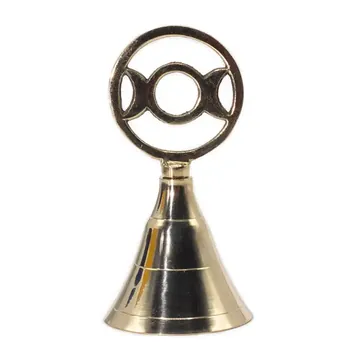
Salt has been thought protective across many cultures, and in British custom it was carried into new homes, sprinkled on thresholds and thrown over the left shoulder after spilling it. Bells were rung to mark holy days and, in folklore, to drive away storms and spirits.
Keeping the tradition today
You do not need to scratch marks into your door frame to enjoy these customs. Many hedge witches keep a few gentle protection charms at home:
- A horseshoe or small piece of old iron above the front door.
- A hagstone on a ribbon by a window or the bed.
- A small rowan cross with red thread in autumn and winter.
- A simple witch bottle of pins, nails and salt by the door.
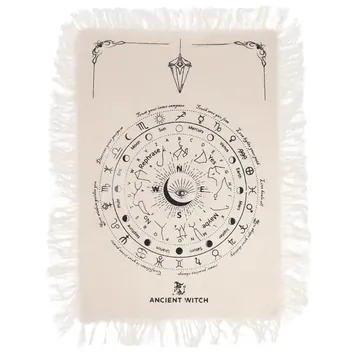
- A daisy wheel drawn in their notebook, or on a card placed by the hearth.
- A small bell rung through the house to clear the air.
For simple step-by-step charms, see our guide to hedge witch spells for beginners, and for the people who once made these charms for their neighbours, read about the cunning folk of Britain.
Folklore is shared here as history and tradition, for interest and reflection.
Questions and answers
What are witch marks?
Witch marks, or apotropaic marks, are symbols such as daisy wheels and overlapping Vs scratched or burned near doors, windows and fireplaces in old British buildings, mostly between about 1500 and 1700. They were meant to protect the openings of a home.
Which way up should a horseshoe hang?
In much of Britain the custom is to hang a horseshoe with the open end upwards, so the luck cannot run out. Some places have the opposite tradition, so either way has history behind it.
What is a hagstone used for?
A hagstone is a stone with a natural hole through it. In British folklore it was hung by beds, doors and in stables for protection and good luck, and was said to let you see the fair folk if you looked through the hole.
Why were shoes hidden in old houses?
No one recorded the reason, but many historians think worn shoes were hidden in walls, floors and chimneys to protect the home, perhaps as a decoy or guardian. Thousands have been found across Britain.
Can I use these protection charms today?
Yes, in a gentle way. A horseshoe over the door, a hagstone by the window, a rowan cross or a simple witch bottle of pins and salt are all easy ways to keep these old customs at home.